
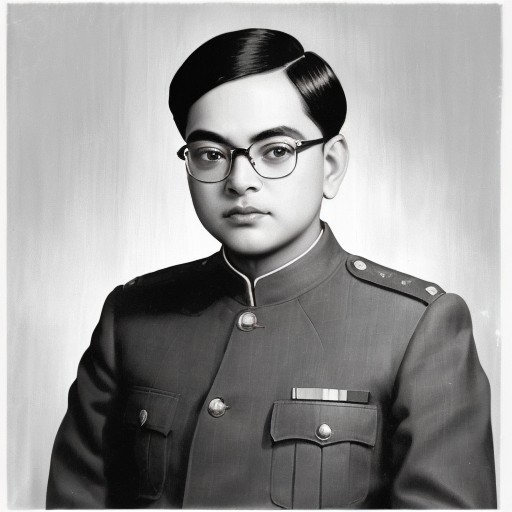
The Enigmatic Legacy of Subhash Chandra Bose
Subhash Chandra Bose, a name that resonates with the spirit of freedom in India, stands as a towering figure in the annals of the Indian independence movement. Born on January 23, 1897, in Cuttack, Odisha, Bose’s journey from a young, ambitious student to a revolutionary leader is nothing short of extraordinary. His charismatic leadership and unwavering commitment to India’s freedom have earned him the title of ‘Netaji,’ or ‘Respected Leader,’ a testament to his profound impact on the nation’s psyche.
Leadership Roles: Architect of the Indian National Army
One of Bose’s most significant contributions to the freedom struggle was his formation of the Indian National Army (INA) in 1942. This revolutionary army was composed of Indian soldiers from Southeast Asia and Indian expatriates who shared a common dream of liberating their homeland from British colonial rule. Under Bose’s dynamic leadership, the INA sought to engage the British forces directly during World War II, thereby shifting the paradigm of the freedom struggle from peaceful protests to armed resistance.
The INA’s military campaigns, particularly the valiant efforts in the Battle of Kohima, showcased Bose’s strategic acumen and his ability to inspire troops. Despite facing insurmountable odds, the INA fought fiercely against the Allied forces, marking a pivotal moment in the history of India’s independence movement.
Military Campaigns: A Fight Against Colonial Rule
Bose’s military strategies were often controversial, as they leaned heavily towards aggressive confrontation with colonial powers. He believed that the only way to achieve freedom was through an organized and armed struggle. During the tumultuous times of World War II, Bose capitalized on the global conflict to rally support for India’s independence. He led campaigns in Malaysia and Singapore, gaining notoriety for his bold tactics and fervent speeches that ignited the nationalist sentiments among Indians.
However, these military campaigns were not without their challenges. The INA faced significant obstacles, both in terms of resources and international support. Yet, Bose’s charisma and unyielding resolve forged a strong bond among the troops, fostering a sense of unity and purpose that transcended regional and cultural differences.
Philosophy and Ideology: A Multifaceted Approach to Freedom
Bose’s ideology was complex, drawing inspiration from various political philosophies, including fascism and communism. He believed in the necessity of armed struggle, often criticizing the non-violent approach championed by Mahatma Gandhi. For Bose, the urgency of the freedom struggle demanded immediate action, and he sought to galvanize not just the Indian populace but also international forces to support the cause.
This ideological divergence sparked debates that continue to reverberate in contemporary discussions about the Indian independence movement. Was Bose’s approach justified? Did his alignment with fascist regimes compromise the ethical foundation of the freedom struggle? These questions challenge the simplistic narratives often presented in history books and invite a deeper exploration of Bose’s motivations and the broader implications of his actions.
International Recognition: The Global Face of Indian Nationalism
Bose’s relentless pursuit of independence earned him international acclaim. His efforts to garner support from countries like Japan and Germany during World War II positioned him as a global figure in the fight against colonialism. The establishment of the Azad Hind Government in 1943 was a bold declaration of India’s sovereignty, garnering attention and recognition on the world stage.
His diplomatic endeavors, though controversial, underscored the complexity of the independence movement. Bose’s ability to negotiate with foreign powers while rallying his compatriots showcased his multifaceted approach to leadership. However, this also raised eyebrows and sparked debates about the ethics of seeking alliances with regimes that had their own agendas.
Death: The Mystery That Endures
The circumstances surrounding Bose’s death remain shrouded in mystery, adding an enigmatic layer to his legacy. Officially, he was reported to have died in a plane crash in Taiwan on August 18, 1945. However, numerous conspiracy theories and claims suggest that he may have survived the crash and lived under an alias until the 1980s. These theories have fueled debates among historians and enthusiasts alike, with some even proposing that he influenced post-colonial India from the shadows.
Recent investigations into the events surrounding Bose’s alleged death have reignited interest in his life and legacy. Did he truly perish in that crash, or did he orchestrate a calculated exit from the public eye? The Indian government has faced pressure to declassify documents related to Bose’s disappearance, as public interest in this national hero continues to grow.
Controversies and Discussions: A Divided Legacy
Bose’s legacy is not without its controversies. His ideologies and methods have sparked heated debates among scholars, political leaders, and the general populace. While many celebrate him as a national hero, others question the implications of his alliances and the moral standing of his military campaigns. This divide continues to shape discussions about nationalism and the means through which freedom was pursued in India.
Furthermore, the portrayal of Bose in popular culture, literature, and media often oscillates between reverence and critique, influencing public perception of his role in history. The recent surge in interest around Bose, particularly in the context of India’s current political landscape, invites further scrutiny and reflection on the complexities of his legacy.
Remembering Subhash Chandra Bose: A Call to Reflect
As India stands at the crossroads of its socio-political journey, the figure of Subhash Chandra Bose serves as a reminder of the diverse paths that led to independence. His unwavering dedication to the cause, coupled with his controversial methods, invites us to reflect on the multifaceted nature of freedom struggles. Bose’s life is a testament to the idea that the quest for independence is not a linear narrative but a tapestry woven with diverse ideologies, strategies, and sacrifices.
In remembering Bose, we honor not only his contributions but also the myriad voices that shaped India’s freedom movement. His legacy challenges us to engage in thoughtful discourse about nationalism, ethics, and the role of armed struggle in achieving liberation. As we delve deeper into the life and times of Subhash Chandra Bose, let us keep the conversation alive, acknowledging the complexities and contradictions that define our history.
Conclusion: A Hero for All Times
Subhash Chandra Bose remains a hero for all times—a figure whose contributions to India’s independence movement continue to inspire generations. His story is not merely one of valor and sacrifice but also one of ideological struggle and moral questioning. As we reflect on his life, let us embrace the lessons it offers, fostering a deeper understanding of the past and its implications for our present and future.
In the end, the legacy of Netaji Subhash Chandra Bose serves as a powerful reminder that the fight for freedom is a complex and multifaceted endeavor, one that requires a blend of courage, sacrifice, and a commitment to justice.


